Description
What exactly is rye flour?
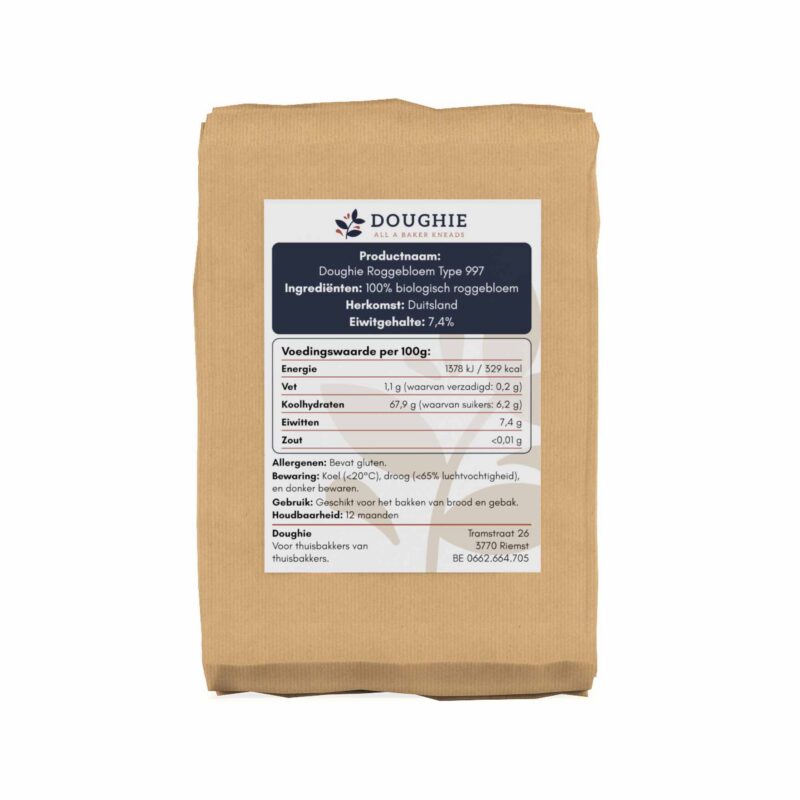
Rye flour is flour based on rye, a grain that behaves very differently from wheat. Rye does contain gluten, but it does not build a classic strong gluten network like wheat does. Therefore, rye flour usually produces less airy, but very flavorful loaves. Type 997 lies in character between lighter sifted rye and a more whole-grain approach. You therefore still get that typical rye note, without the product becoming as heavy as a very dark rye flour. Moreover, because this variant is organic, it is a good fit for home bakers who consciously choose pure ingredients and a natural baking process.
When do you use rye flour in sourdough?
For sourdough, organic rye flour excels particularly in three situations. First, when starting or feeding a sourdough starter. Many home bakers observe faster activity and a lively aroma development with rye. Second, as a flavor enhancer in a wheat recipe: for example, replace 10 to 30 percent of your wheat flour with rye flour, and your bread will immediately gain more depth. Third, in more compact sourdough loaves, crackers, or rustic loaf shapes where a slightly denser crumb fits perfectly. If you are looking for a completely airy white bread, pure rye is less logical. However, if you are seeking more flavor and character, this is actually a wonderful choice.
Properties
- Full and powerful flavor: Rye flour has a distinct, slightly earthy grain flavor that adds extra depth to your baked goods.
- Ideal for breads with character: It is particularly suitable for rye bread and for enriching sourdough bread with more flavor.
- More compact crumb structure: Rye flour generally results in a slightly denser and moister crumb than classic wheat flour.
- Good moisture absorption: The dough absorbs water differently than wheat flour, resulting in a firm and tender end product.
- Perfect to combine: This flour comes into its own beautifully when combined with wheat flour for extra flavor and texture.
- Organic choice: Made from 100% organic rye flour, for home bakers who consciously choose pure ingredients.
- Versatile in use: Suitable not only for bread, but also for crackers and other rustic baking recipes.
Taste, crumb and baking result
Expect an earthy, full, and slightly spicy flavor, with a loaf that typically remains slightly more compact than a loaf made with strong wheat flour. In small percentages, rye flour often makes a loaf more aromatic without making it heavy. In larger percentages, you get a darker crumb, less stretch in the dough, and a loaf that feels juicy and dense rather than open and airy. Many home bakers appreciate rye for precisely this reason: it gives a loaf an artisanal appearance and a distinct identity of its own.
For whom is this a good choice?
This organic rye flour is suitable for home bakers who want to give their starter a stronger effect, bake more consciously, and seek more flavor in their bread. Even those with limited experience can work well with it, as long as you know that rye usually performs best in combination with wheat. For advanced bakers, it is a great building block for adding depth to recipes.
Practical baking tips for home bakers
Feel free to start bread recipes with a small proportion of rye flour, for example 10 to 20 percent of the total amount of flour. This way, you get to know the effect without your dough immediately becoming much more difficult. If you use rye flour in your starter, the starter may feel a bit thicker than a wheat starter. Also, be careful with extra water: rye can react differently than wheat, and the dough often feels stickier. So, it is better to work with wet hands or a dough scraper than with extra flour during shaping.
Frequently Asked Questions
- Is rye flour good for a sourdough starter?
Yes. Rye is often chosen to get a starter going or to give it new life, because many home bakers find that the fermentation proceeds actively and stably.
- Can I bake bread using only rye flour?
That is possible, but the result will be more compact and requires a different approach than a classic wheat bread. For many home bakers, a combination with wheat flour works best.
- When should I choose rye flour instead of wheat flour?
Choose rye flour when you want more flavor, a darker bread, and extra support for your starter. Choose wheat flour when airiness and volume are your priority.
In summary
Organic rye flour type 997 for sourdough is a strong choice for home bakers who want to bake consciously while clearly understanding the role a product plays in a recipe. You use this product primarily for sourdough starters, flavorful sourdough breads, rye blends, and denser loaves. By thoroughly understanding the properties of 100% organic rye flour, you bake with more confidence and achieve a result that better matches the bread you have in mind. That fits perfectly with Doughie: from home bakers for home bakers.